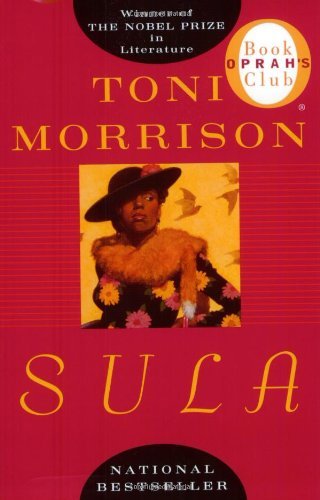
One of my favorite books of all time.
I’m rereading this for the second time and am again struck by Morrison’s immersive language and ability to absolutely transport the reader into Nel’s world. Producing the majority of her work in the 70s and 80s, Morrison didn’t start writing until middle age and has repeatedly reflected on her initial hesitance to start. Thank God she did.
Morrison’s work is famously centered around Black women – notably excluding white characters – countering the rhetoric that this limits the power of her stories and of her narrative. Sula is a continuation of this narrative, portraying themes of race, identity, sexuality/promiscuity, and the perpetration of societal norms.
One of my most favorite parts of this book is the opening chapter – the sprawling land of the Bottom, the vibrant characters and scenery coming to life. And just two pages in, amid this beautiful description of a disenfranchised suburb, Morrison writes,
“… it would be easy for the valley man to hear the laughter and not notice the adult pain that rested somewhere under the eyelids, somewhere under their head rags and soft felt hats, somewhere in the palm of the hand, somewhere behind the frayed lapels, somewhere in the sinew’s curve. He’d have to stand in the back of Greater Saint Matthew’s and let the tenor’s voice dress him in silk, or touch the hands of the spoon carvers (who had not worked in eight years) and let the fingers that danced on wood kiss his skin. Otherwise the pain would escape him even though the laughter was part of the pain.”
An incredible illustration of the feelings of those marginalized most in society. Morrison writes this to set up the Bottom’s origin – an ex-slave being tricked into accepting difficult hill land instead of the fertile valley land of Medallion, which white farmers continued to monopolize. In a lovely twist-of-fate, Morrison updates this beautifully, writing,
“Still, it was lovely up in the Bottom. After the town grew and the farm land turned into a village and the village into a town and the streets of Medallion were hot and dusty with progress, those heavy trees that sheltered the shacks up in the Bottom were wonderful to see. And the hunters who went there sometimes wondered in private if maybe the white farmer was right after all. Maybe it was the bottom of heaven.”
This introduction alone beautifully illustrates the Morrison’s talent for portraying irony in human nature. Morrison’s third work focuses on a pair of girls – Sula and Nel – as they grow through life together. Fantasizing about boys in girlhood to growing as women and meeting societal pressure to marry and have children, Morrison does an incredible job of illustrating dichotomy in women’s needs and desires. Sula maintains her independence from marriage and monogamy, and as Morrison writes,
“Sula was trying [men] out and discarding them without any excuse the men could swallow.”
“… feeling no obligation to please anybody unless their pleasure pleased her.”
A feminist icon, but revolutionary for her time in the Bottom.
The book starts not following Sula, or Nel, but their mothers and grandmothers. All the women who came before them and their roles in society – Sula’s grandmother becoming a matriarch, her mother contradicting societal norms in her own way, Nel’s mother embracing her role as a wife and mother. Our introduction to the book is rooted in generational trauma, strained relationships between mother and child and, in my opinion, builds one of the main pillars of the story – women’s relationship to motherhood. In an argument between Sula’s mother and grandmother, her grandmother reveals the sacrifices she had to make as a mother and confronts her daughter’s doubts in her love for her children, illustrating the generational effects of these intricate relationships. Sula redefines what femininity looks like – her grandmother, Eva, maintaining her independence while providing for her family, Sula manifesting her own role in society. Morrison’s portrayal of marriage and relationships is significant in both Sula and Nel’s self-exploration. In relation to female identity, one passage that has struck me twice now is,
“As Reverend Deal moved into his sermon, the hands of the women unfolded like pairs of raven’s wings and flew high above their hats in the air. They did not hear all of what he said; they heard the one word, or phrase, or inflection that was for them the connection between the event and themselves. For some it was the term ‘Sweet Jesus.’ And they saw the Lamb’s eye and the truly innocent victim: themselves. They acknowledged the innocent child hiding in the corner of their hearts, holding a sugar-and-butter sandwich. That one. The one who lodged deep in their fat, thin, old, young skin, and was the one the world had hurt. Or they thought of their son newly killed and remembered his legs in short pants and wondered where the bullet went in. Or they remembered how dirty the room had looked when their father left home and wondered if that is the way the slim, young Jew felt, he who for them was both son and lover and in whose downy face they could see the sugar-and-butter sandwiches and feel the oldest and most devastating pain there is: not the pain of childhood, but the remembrance of it.”
Morrison’s summary of girl- and womanhood is incredible, illustrating the pain and insecurities many women carry into and go through in adulthood, and how it all connects. And the role of religion in getting through that pain. The constant of religion – evil, God, and His mercy – in this story was notable, found in the robins announcing Sula’s return to the Bottom, in discrimination and in poverty. Perseverance through evil being embraced as a part of life. Sula’s presence embodying ‘evil’ in the Bottom and her effect on others in the community, particularly their relationships. A flawed character, I empathized with Sula and appreciated her contrast to Nel’s character of wife and mother (who I could go into another time).
I love love love this book. Thank you Toni Morrison for being alive, for putting words to the female experience, and for writing as you did. ❤

 Penelope Margot